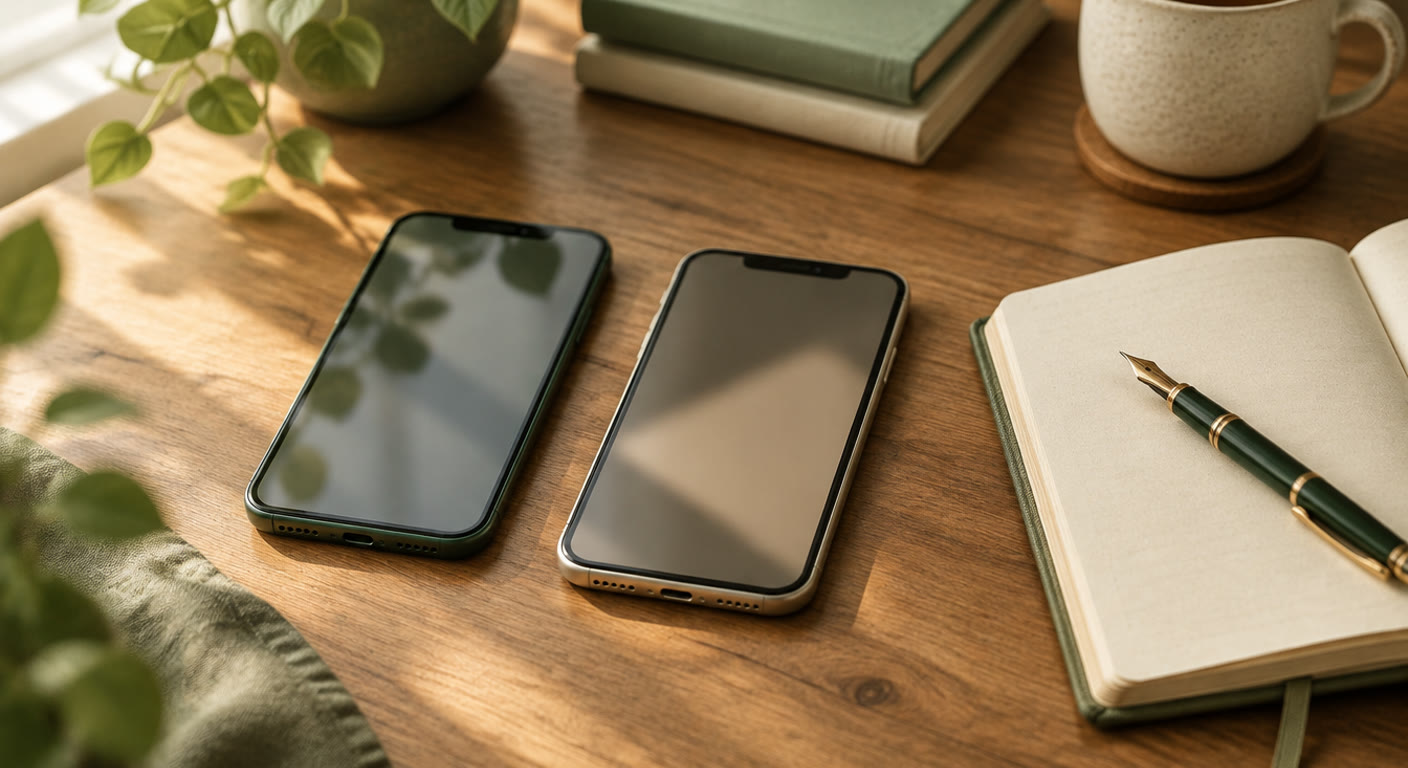

If you journal while you're in therapy, there's a good chance you've had this small, nagging debate with yourself. Do you keep using the notebook on your bedside table? Or move everything into an app, where it's searchable and backed up, but also… somewhere else?
It's a fair question, and it feels heavier than a normal stationery decision because of what's in the pages. A journal kept alongside therapy tends to hold the rawest material you have: the thing you couldn't say out loud yet, the pattern you're only starting to notice, the entry you wrote at 2 a.m. and might bring to your next session.
This guide is a straight comparison of journaling with a therapist, digital vs paper. Not a sales pitch for either. Paper is a genuinely excellent choice for a lot of people, and we'll say so plainly. Digital has real strengths too. What we want to give you is a clear side-by-side and a short framework for deciding which one fits your situation.
One quick note on scope: if you're looking for how to actually choose what to show your therapist, and how to share it, we've covered that separately in sharing your journal with a therapist safely. This piece is about the format itself.
Why the Format Question Matters More Here
For a gratitude list or a reading log, paper vs digital is mostly about taste. When your journal sits next to therapy, three things raise the stakes a little:
- The content is more sensitive. It may include other people, private history, and thoughts you haven't fully made sense of yet.
- It may travel. Even if it never leaves your hands, you might bring it into a session, read from it, or summarise it.
- You'll want to look back. Part of the value of journaling alongside therapy is noticing how things shift over weeks and months, which means the journal needs to still be there, and still be readable, later on.
So the real question isn't "which is better?" It's "which format protects what I care about, given how I'll actually use it?"
Paper Journals: The Honest Pros and Cons
The pros
- No server, no account, no breach. A notebook can't be hacked remotely. There's no company holding a copy and no password database to leak.
- Tactile and slow, in a good way. Handwriting is slower than typing. Researchers who study note-taking have found that this slowness tends to push people to summarise and rephrase rather than transcribe, and many people find the same thing happens with feelings: writing by hand makes them pause.
- Zero learning curve. No settings, no updates, no battery, nothing to sync. It works during a power cut and on a plane.
- Easy to bring into the room. You can open it, read a line aloud, and close it again. Nothing is copied unless you choose to copy it.
- Clear physical boundaries. You always know exactly where your journal is, and there's only one of it.
The cons
- One copy means one point of failure. A fire, a flood, a coffee spill, a bag left on a train. Years of entries can be gone in an afternoon, with no way back.
- Privacy depends on your home. Paper is only as private as the drawer it lives in. For people who share a living space, that's often the weakest link, not a hacker.
- Hard to search. Finding "that entry from March about my sister" can mean flipping through three notebooks.
- Patterns are hard to see. You can reread, but spotting a theme across six months of handwriting takes real effort, and it's the thing many people most want from journaling alongside therapy.
Digital Journals: The Honest Pros and Cons
The pros
- Searchable history. Type a word, a name, or a month, and the entries are there. Bringing a specific moment to mind before a session takes seconds.
- Survives physical loss. With sync or backup, a lost phone or a burst pipe doesn't take your journal with it.
- Available where you are. Write on your phone on the bus, reread on your laptop in the evening.
- Structure when you want it. Prompts, tags and mood check-ins can make it easier to get started on a hard day.
- Looking back is easier. Being able to scroll, filter or see trends across months is where digital journals genuinely shine.
The cons
- Someone else may be able to read it. This is the classic digital downside. With many apps, your entries sit on a company's servers in a form the company can technically unlock. "We'd never read your journal" is a policy. Whether they can is a design question.
- Copies multiply quietly. Exports, screenshots, email attachments and device backups can scatter fragments of your journal into places you didn't intend. (We go into this in privacy boundaries when sharing digital journals.)
- More moving parts. Passwords, updates, batteries and notifications all add a little friction, and a little to manage.
- Screens can pull you sideways. Opening your phone to journal and ending up in your inbox is a real thing.
Side by Side: What Actually Differs
Here's the comparison boiled down to the factors that matter most for therapy-adjacent journaling.
- Who could read it: Paper, anyone with physical access. Digital, anyone with access to your unlocked device, plus, with many apps, the provider.
- Risk of loss: Paper, high if there's only one copy. Digital, low if it's synced or backed up.
- Bringing it into a session: Paper, simple, open the notebook and read. Digital, simple too, especially reading from your own screen, but easier to over-share by sending files.
- Finding a specific entry: Paper, slow. Digital, fast.
- Seeing patterns over months: Paper, possible but effortful. Digital, much easier.
- Setup and upkeep: Paper, none. Digital, an account, a password, and a few settings worth checking.
- The feel of writing: Paper, slower and tactile. Digital, quicker and more flexible.
Notice that neither column wins outright. Paper's biggest strengths are privacy from third parties and simplicity. Digital's are durability and looking back. The interesting question is whether you can have the important parts of both.
A Five-Question Framework for Choosing
Work through these honestly. Your answers will point you to the right format much more reliably than any general rule.
1. Who could realistically open it? Picture the people around you, not hackers in the abstract. If you live alone or have a private, lockable space, paper's physical privacy is strong. If you share a home and a notebook would be easy to find, a passcode-protected device may actually be more private. And if the thought of a company being able to read your entries bothers you, that rules out many digital apps but not all of them (more on that below).
2. How will it come into the room? Some people read a line aloud in session; others prefer to summarise from memory; others never bring the journal at all. If you like reading from the page and closing it again, paper is wonderfully simple. If you want to pull up a specific entry quickly, digital helps. Either way, how and what you share is yours to decide with your therapist.
3. What would losing it cost you? If your journal is mostly in-the-moment processing that you rarely revisit, losing a notebook would sting but not devastate. If it's two years of history you lean on, durability starts to matter a lot.
4. Do you want to look back at patterns? At MindfulFlow we think about journaling in three steps: Record, Reflect, Refine. You Record honestly, without writing for an audience. You Reflect by noticing themes over time. You Refine by adjusting one small thing based on what you've noticed. Paper handles Record beautifully. Reflect is where it gets harder, because patterns across months are easy to miss when they're spread over handwritten pages. If Reflect is the part you value most, that tilts toward digital.
5. Which one will you actually keep using? The best journal is the one you return to. If a notebook is what gets you writing, that matters more than any feature list.
Reading your answers:
- Privacy at home is solid, you rarely revisit old entries, and you love the page: paper is a great choice. Keep it somewhere private, and consider whether a second copy of anything important is worth making.
- Durability and looking back matter most, and you're comfortable trusting a provider: a standard digital journal will serve you well.
- You want digital's durability and pattern-spotting, but a provider being able to read your entries is a dealbreaker: keep reading.
Plenty of people also land on a hybrid: a paper notebook for raw, in-the-moment writing, and a digital journal for the short reflections they want to find again later. That's a perfectly sensible answer.
Closing the Gap: A Digital Journal the Provider Can't Read
The biggest reason privacy-conscious people stick with paper is simple: no one else holds a copy. With most digital journals, someone does.
End-to-end encryption changes that. Your entries are encrypted on your own device before they're synced, and only you hold the key that unlocks them. The provider stores and syncs scrambled data it has no way to open. That's not a promise about behaviour; it's a property of how the system is built. (If you want the broader picture first, our guide to whether digital journaling apps are safe and private is a good starting point.)
In practice, that keeps paper's most important privacy property, no third party can read it, while adding what paper can't offer: a journal that survives a lost phone, is searchable, and makes patterns easier to see.
It's worth being honest about the limits, too:
- Your device is still the front door. Encryption protects entries from the provider, not from someone using your unlocked phone. A good passcode matters, just as a good drawer does for paper.
- Anything you export or screenshot leaves the protected space. Once a copy is outside the app, it's only as private as wherever it ends up.
- Recovery works differently. If the provider never holds your key, it can't simply reset your way back in. Keep your recovery key somewhere safe.
When you're comparing apps, a few quick questions do most of the work: Who holds the key? Can the company read my entries if it wanted to? Are backups and exports protected? What happens if I forget my password? Our privacy-first journaling app checklist walks through the full list.
This is the balance we built MindfulFlow Journal around: entries encrypted on your device with a key we never hold, synced so they outlast any single phone, and organised so you can look back across months. If you'd like to try it alongside your notebook, rather than instead of it, you can see how a private journal handles this — no credit card needed.
A gentle, honest note: journaling can be a helpful way to notice your thoughts between sessions, but it isn't therapy and isn't a replacement for it. If you're struggling, your therapist or doctor is the right person to talk to, and whichever journal you choose can simply sit alongside that support.
The Bottom Line
The digital vs paper question doesn't have a universal winner, and it doesn't need one.
Paper is private from third parties, simple, tactile, and easy to bring into a session. Its weaknesses are loss and the effort it takes to look back. Digital is durable, searchable, and good at surfacing patterns. Its classic weakness is that a provider might be able to read it, and that one is solvable with end-to-end encryption.
So think about who could open it, how it'll come into the room, what losing it would cost, and whether looking back matters to you. Then pick the format you'll actually reach for, and write.
Do you journal on paper, digitally, or a bit of both? And what made you choose it? Share in the comments.